Showing posts with label management. Show all posts

Wednesday, March 21, 2012

Delay your project, protect your future


One of the dangers of Agile is that teams are so busy sprinting and delivering potentially shippable projects, that they forget to invest in becoming more productive in the future.

Let's use some basic economics to illustrate this problem.  Assume your team has a top productivity of X. It doesn't matter the unit you pick - story points per iteration, function points per month -  but let's assume your team cannot produce more than X.


Now, one of the things you can do with productivity is move it around. For instance, google allows employees to invest part of their work week on pet projects. So if we put that on a vertical axis, we get something like this:
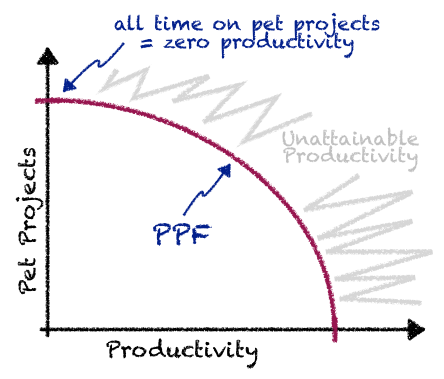

This curve is called a Production Possibility Frontier, or PPF, and it represents your team's limit in terms of productivity. This means the only way you'll make your team more productive is by moving the PPF! And the way to achieve this is through investment.

You may argue that google pet projects are an investment, but what I mean is direct investment in improving productivity. For instance, you could invest in improving your QA infrastructure, so that developers don't spend so much time building and fixing tests. Or you could invest in tools to improve your overall capacity to deliver, like the OutSystems' Agile Platform. (disclaimer, I work for OutSystems! ;).

When you do this type of investment, the end result is that you move the PPF to the right, therefore increasing your team's capacity to deliver.


Easy, right? So why isn't everybody doing these investments and increasing their productivity? Why do we meet so many inefficient teams and R&D departments?

Turns out there is a catch. These improvements are not continuous, and work in leaps. This means you need to go all the way to see the results of your investment. If you study a new tool for a couple of weeks and stop the investigation before something actionable comes out of the study, you're just throwing your time and money out the window...

But guess what happens as soon as a the project stars to slip? We choose the short term solution, and increase the productivity of the team at the expense of our investment.

Standing up to your stakeholders and delaying a milestone to protect your future is the hard part in making your team more productive. And I hope this short post gives you a bit of ammunition to go in the right direction! :)

Wednesday, January 19, 2011

What's wrong with ScrumBut?

When I talk to other Agilists about SCRUM, I usually get two very extreme reactions to this methodology:

On one side, I get people that say you've got to follow all the rules. That's what SCRUM is! There is no but!

On the other side, I get people saying that there's no such thing as a one size fits all methodology, so you always need to adapt SCRUM for your particular scenario.

Now, I don't agree that you need to blindly follow all the rules of SCRUM. That's not Agile at all... remember the 1st rule in the Agile Manifesto?  "Individuals and interactions over processes and tools". Seems clear to me that, if your team agrees that some part of SCRUM can be improved, the Agile Manifesto is there to back you up.

But...

Just because it is ok to change SCRUM, doesn't mean you should. Failing to properly implement SCRUM is not a valid excuse to change the process "to fit your organization". That's the the type of attitude that gives ScrumBut a bad name!

Before adapting SCRUM to your organization, you need to implement and use original SCRUM for a while. It's only when you finally get SCRUM running smoothly on your organization (and that will take some time!) that you and your team can move to phase 2: Analyze the process, do retrospectives, and improve the process to better suite your needs.

And that's when the real fun of Agile and SCRUM begins!

Saturday, June 26, 2010

Giving Gantt charts some Agile love!

Gantt charts have a really bad reputation these days. They're strongly associated with the waterfall methodology, are considered an evil tool that managers use to micro-manage teams, and are usually classified as outdated delusions of certainty about projects that are subject to lots of change.

But still, I love Gantt charts! They're a great way to keep everybody in synch with the overall timeline of a project, team allocation, and how the project dates relate to other important dates.

My secret to make Gantt charts successful is easy: Keep It Simple!

Here are a few tips on how to achieve Gantt Nirvana:
  • You have to be able to produce the Gantt really quickly. The problem with most Gantt charts is that creating them is a project in itself. And that means that by the time you publish them, they're already out-of-date.
  • It must be really easy to change the Gantt. The Gantt's main purpose is communication. So when the project changes, the Gantt must also change. 
  • Gantt's don't work well with lots of data. Forget about the never-ending WBSs. It's too much detail and too much work. User stories are more than enough detail.
  • Assign to teams, not individuals. It's up to the team to organize how they solve problems. Besides, it means a lot less work for you!
  • Gantt's don't scale well vertically. Don't make a stair case of user stories if they all belong to the same project. Show them one after the other, with the most important first, of course!
  • Be precise. There's not much point communicating something that's wrong. Take into account the team velocity, vacations, national holidays, ...
  • Add milestones and releases. Make it obvious when things will be made available. Just because a user story is completed next week, that doesn't mean it will be available in production.
  • Worry about the future. Retrospectives are important learning tools, but usually it's more important to communicate were we are heading. Focus on that.
At OutSystems, we used our own Agile Platform to automate the entire process of creating the Gantt. All I have to do is click a button, and hey presto! Here's how they look:


Sunday, May 23, 2010

Beating the Delivery Deadline!

I'm a product delivery manager at OutSystems. In a nutshell, my job is to make sure new versions of the Agile Platform are released on time, with quality, and with all the features agreed upon.

Last Friday we released version 5.1 beta of the Agile Platform! And yes, it was released on time, with quality, and with everything the stakeholders were expecting! Cool, hum?

And if you're wondering, this wasn't a one time lucky shot. This is the 4th version since I'm a delivery manager that we've pulled this off!

Actually, this shouldn't be anything to be amazed about... But the fact of the matter is that it is so unusual, that it surprises most people I know in the software industry. So I decided to share some principles I follow to make sure we ship on time:

  • Embrace change: One of the most anticipated features on 5.1 are the Wizards. Funny enough, the wizards weren't part of 5.1 when it started! This could've been a major stress factor, but it wasn't! From the moment we understood it was the right decision, we were more than thrilled to make it happen!
  • Don't add, swap: It's really easy to add a bunch of features to a version, just so see its ship date delayed over and over. Swapping puts a price on features and forces everyone to prioritize. This keeps everyone focused on shipping the most important things first!
  • Say 'No': It happens on every version. The end date gets near and everybody wants to add just one more thing. It's much easier to say "yes", but you'll regret it for much longer. I usually put it like this: Is it worth it to miss the ship date to add this last minute feature? It usually isn't...
  • Know your teams: 5.1 got out on time because we were able to predict how long it would take to build! And the reason we were able to predict this (even with so much change!) is because we studied past versions to learn how long we take to do stuff. And not just the time software takes to build, we also consider interactions with other teams, user feedback, meetings, ...
  • Establish design rules: It's really easy to derail when developing software. Establishing good design rules (visions, goals, guidelines, ...) is a great way to make sure everyone is on the same page. To be honest, I usually don't come up with these rules. The teams do! I just help teams stick to them.
  • Get out of the way: I'm always available to give help and advice to my teams. But once I feel they're on track, I get out of the way. This is actually much harder to do than it seems, but once you have this level of trust with your teams, it's pure bliss - for both the manager and the team!
  • Ship: There's always last minute bugs. There's always a reason to stop the presses and hold the version. Turns out most last minute bugs only occur when the planets are aligned and it's raining in the Kalahari... so ship anyway! You can fix it tomorrow!
These might seem like easy enough tips, but to each of them there's a lot of preparation, trust, and discernment going on! Not only that, there's a huge requirement to make any of these tips work:

You need amazing teams working with you!

Lucky for me, I work with the best teams on the planet!